
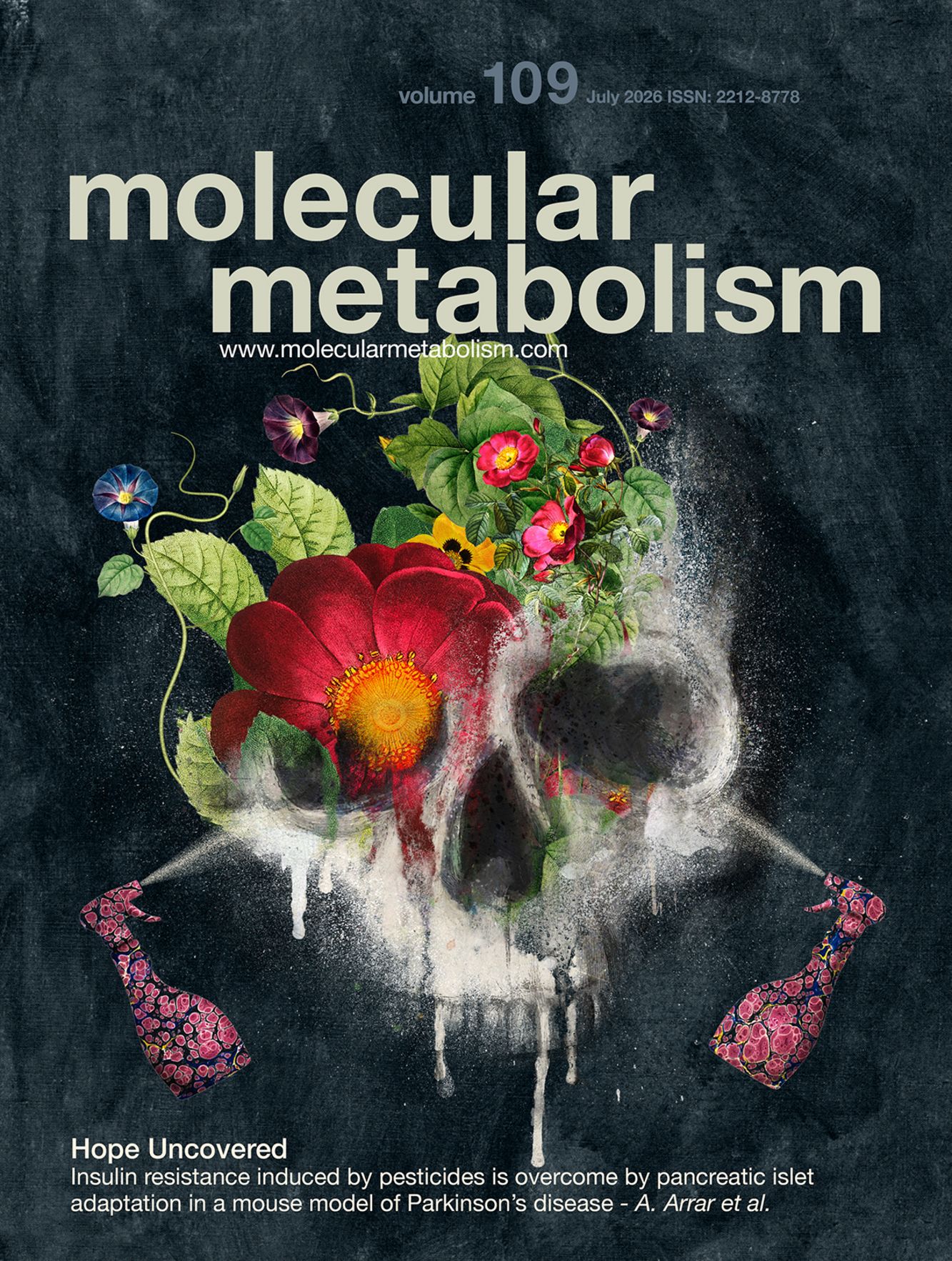


Cover Story Current Issue

Epidemiological evidences provide proof of concept that certain pesticides are involved in metabolic disorders, but also in the pathophysiology of Parkinson's disease (PD). In addition, large prospective cohort studies reported that type 2 diabetes (T2D) and PD are epidemiologically associated, including an elevated risk of developing PD in patients with T2D.
Current Issue
Fructose-induced synaptic and neuronal adaptations at neuropeptide Y/agouti-related peptide neurons

Fructose-induced synaptic and neuronal adaptations at neuropeptide Y/agouti-related peptide neurons
Fructose is a naturally-occurring sugar, consumed in excess as sweeteners, and is linked to the development of obesity. Fructose is consumed with glucose (dextrose) in added sugars, but while dextrose produces satiety, excessive fructose intake promotes hyperphagia through the brain. However, the neurological effects of dietary fructose are not clearly defined. We fed male and female mice standard chow, a 60% high fructose, or 60% high dextrose diet and found that fructose- and dextrose-fed mice ate more calories and gained more body fat despite increasing fat oxidation and energy expenditure. Furthermore, their metabolic syndromes were more prominent in male mice, who also developed glucose intolerance. To define the neurological effects underlying the obesogenic actions of fructose, we performed ex vivo patch-clamp recordings from orexigenic Neuropeptide Y/agouti-related peptide (NPY/AgRP) neurons in the arcuate nucleus. Fructose feeding uniquely increased synaptic excitation at NPY/AgRP neurons, which remained elevated with sustained fructose exposure; this excitation may arise from glutamatergic neurons in the dorsomedial hypothalamic nucleus. Terminating fructose feeding reversed this synaptic excitation at male but not female NPY/AgRP neurons. Furthermore, chronic but not acute fructose feeding in male mice also irreversibly activated NPY/AgRP neurons even following fructose withdrawal. Interestingly, despite sex-dependent fructose-mediated plasticity at NPY/AgRP neurons, a prolonged fructose withdrawal increased innate fructose preference in both male and female mice. Taken together, these findings showed that fructose elicited synaptic and neuronal excitation at NPY/AgRP neurons that can be long-lasting. These actions are consistent with that seen during hunger and may thus promote hyperphagia in the expression of fructose-mediated obesity.
Articles in Press
Fructose-induced synaptic and neuronal adaptations at neuropeptide Y/agouti-related peptide neurons
Fructose-induced synaptic and neuronal adaptations at neuropeptide Y/agouti-related peptide neurons
Fructose is a naturally-occurring sugar, consumed in excess as sweeteners, and is linked to the development of obesity. Fructose is consumed with glucose (dextrose) in added sugars, but while dextrose produces satiety, excessive fructose intake promotes hyperphagia through the brain. However, the neurological effects of dietary fructose are not clearly defined. We fed male and female mice standard chow, a 60% high fructose, or 60% high dextrose diet and found that fructose- and dextrose-fed mice ate more calories and gained more body fat despite increasing fat oxidation and energy expenditure. Furthermore, their metabolic syndromes were more prominent in male mice, who also developed glucose intolerance. To define the neurological effects underlying the obesogenic actions of fructose, we performed ex vivo patch-clamp recordings from orexigenic Neuropeptide Y/agouti-related peptide (NPY/AgRP) neurons in the arcuate nucleus. Fructose feeding uniquely increased synaptic excitation at NPY/AgRP neurons, which remained elevated with sustained fructose exposure; this excitation may arise from glutamatergic neurons in the dorsomedial hypothalamic nucleus. Terminating fructose feeding reversed this synaptic excitation at male but not female NPY/AgRP neurons. Furthermore, chronic but not acute fructose feeding in male mice also irreversibly activated NPY/AgRP neurons even following fructose withdrawal. Interestingly, despite sex-dependent fructose-mediated plasticity at NPY/AgRP neurons, a prolonged fructose withdrawal increased innate fructose preference in both male and female mice. Taken together, these findings showed that fructose elicited synaptic and neuronal excitation at NPY/AgRP neurons that can be long-lasting. These actions are consistent with that seen during hunger and may thus promote hyperphagia in the expression of fructose-mediated obesity.
Registration & Abstract Submission are open!

13th
Helmholtz Diabetes Conference
Munich, 21-23. Sep 2026

2024 impact factor: 6.6
You are what you eat
Here is a video of Vimeo. When the iframes is activated, a connection to Vimeo is established and, if necessary, cookies from Vimeo are also used. For further information on cookies policy click here.
Hinweis zu Werbung in Videos ▼
Auf Werbeinhalte, die vor, während oder nach Videos von WEBSITE-URL eingeblendet werden, hat WEBSITE-URL keinen Einfluss. Wir übernehmen keine Gewähr für diese Inhalte. Weitere Informationen finden Sie hier.