
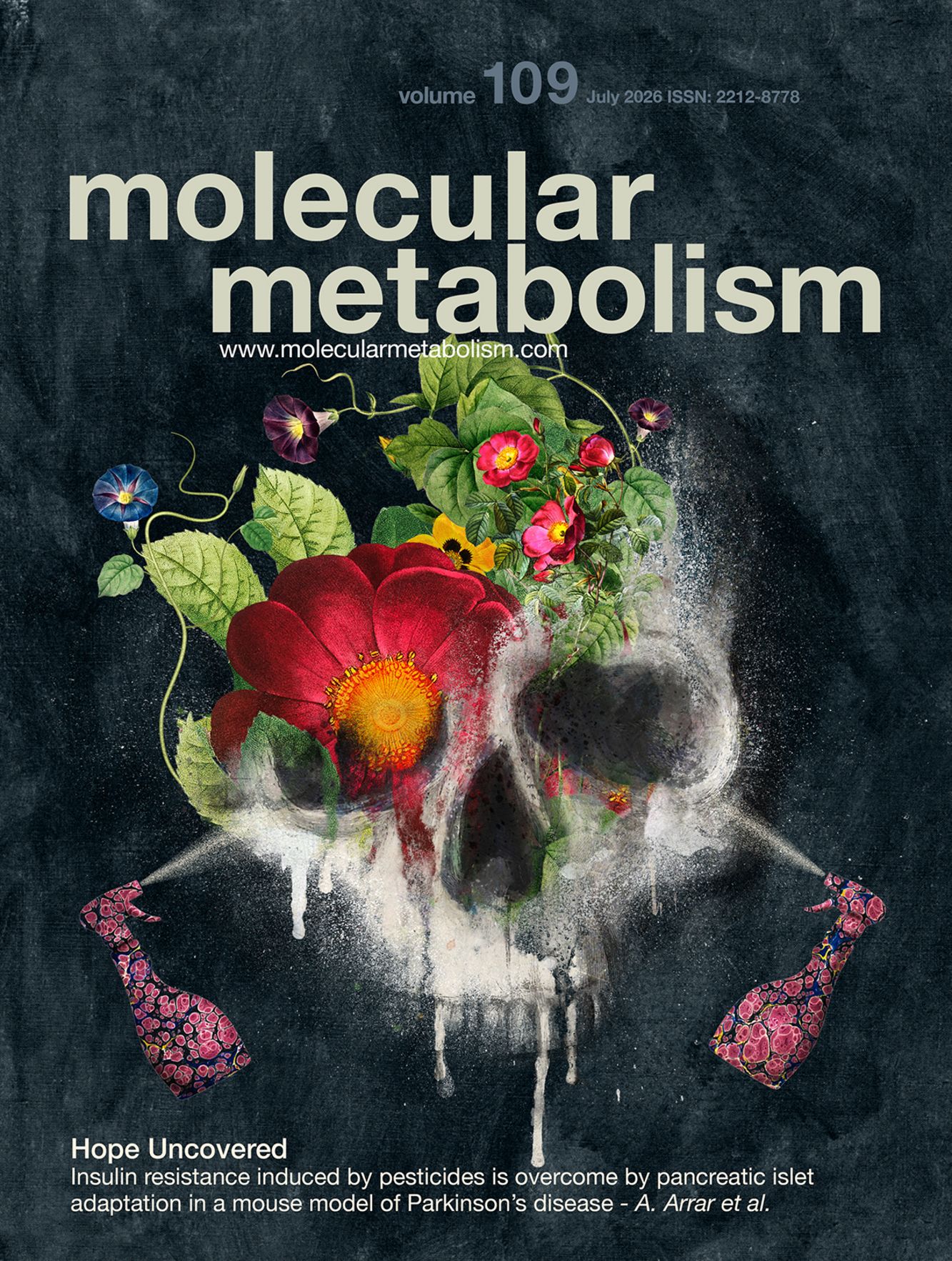


Cover Story Current Issue

Epidemiological evidences provide proof of concept that certain pesticides are involved in metabolic disorders, but also in the pathophysiology of Parkinson's disease (PD). In addition, large prospective cohort studies reported that type 2 diabetes (T2D) and PD are epidemiologically associated, including an elevated risk of developing PD in patients with T2D.
Current Issue
Pde5a deficiency prevents diet-induced obesity via adipose cAMP-PKA activation enhancing fat browning

Pde5a deficiency prevents diet-induced obesity via adipose cAMP-PKA activation enhancing fat browning
Objective
Cyclic nucleotides are central regulators of adipogenesis and adaptive thermogenesis, with their intracellular concentrations tightly controlled by phosphodiesterases (PDEs). Among them, phosphodiesterase type 5 (PDE5A) regulates cyclic guanosine monophosphate (cGMP) turnover in adipocytes. Although PDE5A inhibition has been explored in diabetes, its role in systemic metabolism remains poorly defined.
Methods
We employed different Pde5a knockout mouse models to investigate the impact of PDE5A deficiency on adipose tissue biology and whole-body energy homeostasis. Phenotypic, histological, and metabolic assessments were performed under chow and high-fat diet conditions, with a focus on thermogenic activation, hepatic lipid accumulation, and glucose metabolism.
Results
Loss of Pde5a resulted in robust activation of brown adipose tissue and moderate browning of white adipose depots, accompanied by a reduction in hepatic lipid content. Upon high-fat diet challenge, Pde5a-deficient mice exhibited resistance to obesity, improved glucose handling, and enhanced thermogenic capacity. Mechanistically, these protective effects originated from early developmental knockdown of Pde5a, which induced metabolic reprogramming via activation of the cAMP–protein kinase A (PKA) signaling pathway. The convergence of cGMP and cAMP signaling cascades orchestrated systemic metabolic adaptations.
Conclusions
Our study identifies PDE5A as a previously unrecognized regulator of thermogenesis and energy balance. Targeting PDE5A may therefore represent a promising adjuvant therapeutic approach for the treatment of metabolic disorders.
Articles in Press
Pde5a deficiency prevents diet-induced obesity via adipose cAMP-PKA activation enhancing fat browning
Pde5a deficiency prevents diet-induced obesity via adipose cAMP-PKA activation enhancing fat browning
Objective
Cyclic nucleotides are central regulators of adipogenesis and adaptive thermogenesis, with their intracellular concentrations tightly controlled by phosphodiesterases (PDEs). Among them, phosphodiesterase type 5 (PDE5A) regulates cyclic guanosine monophosphate (cGMP) turnover in adipocytes. Although PDE5A inhibition has been explored in diabetes, its role in systemic metabolism remains poorly defined.
Methods
We employed different Pde5a knockout mouse models to investigate the impact of PDE5A deficiency on adipose tissue biology and whole-body energy homeostasis. Phenotypic, histological, and metabolic assessments were performed under chow and high-fat diet conditions, with a focus on thermogenic activation, hepatic lipid accumulation, and glucose metabolism.
Results
Loss of Pde5a resulted in robust activation of brown adipose tissue and moderate browning of white adipose depots, accompanied by a reduction in hepatic lipid content. Upon high-fat diet challenge, Pde5a-deficient mice exhibited resistance to obesity, improved glucose handling, and enhanced thermogenic capacity. Mechanistically, these protective effects originated from early developmental knockdown of Pde5a, which induced metabolic reprogramming via activation of the cAMP–protein kinase A (PKA) signaling pathway. The convergence of cGMP and cAMP signaling cascades orchestrated systemic metabolic adaptations.
Conclusions
Our study identifies PDE5A as a previously unrecognized regulator of thermogenesis and energy balance. Targeting PDE5A may therefore represent a promising adjuvant therapeutic approach for the treatment of metabolic disorders.
Registration & Abstract Submission are open!

13th
Helmholtz Diabetes Conference
Munich, 21-23. Sep 2026

2024 impact factor: 6.6
You are what you eat
Here is a video of Vimeo. When the iframes is activated, a connection to Vimeo is established and, if necessary, cookies from Vimeo are also used. For further information on cookies policy click here.