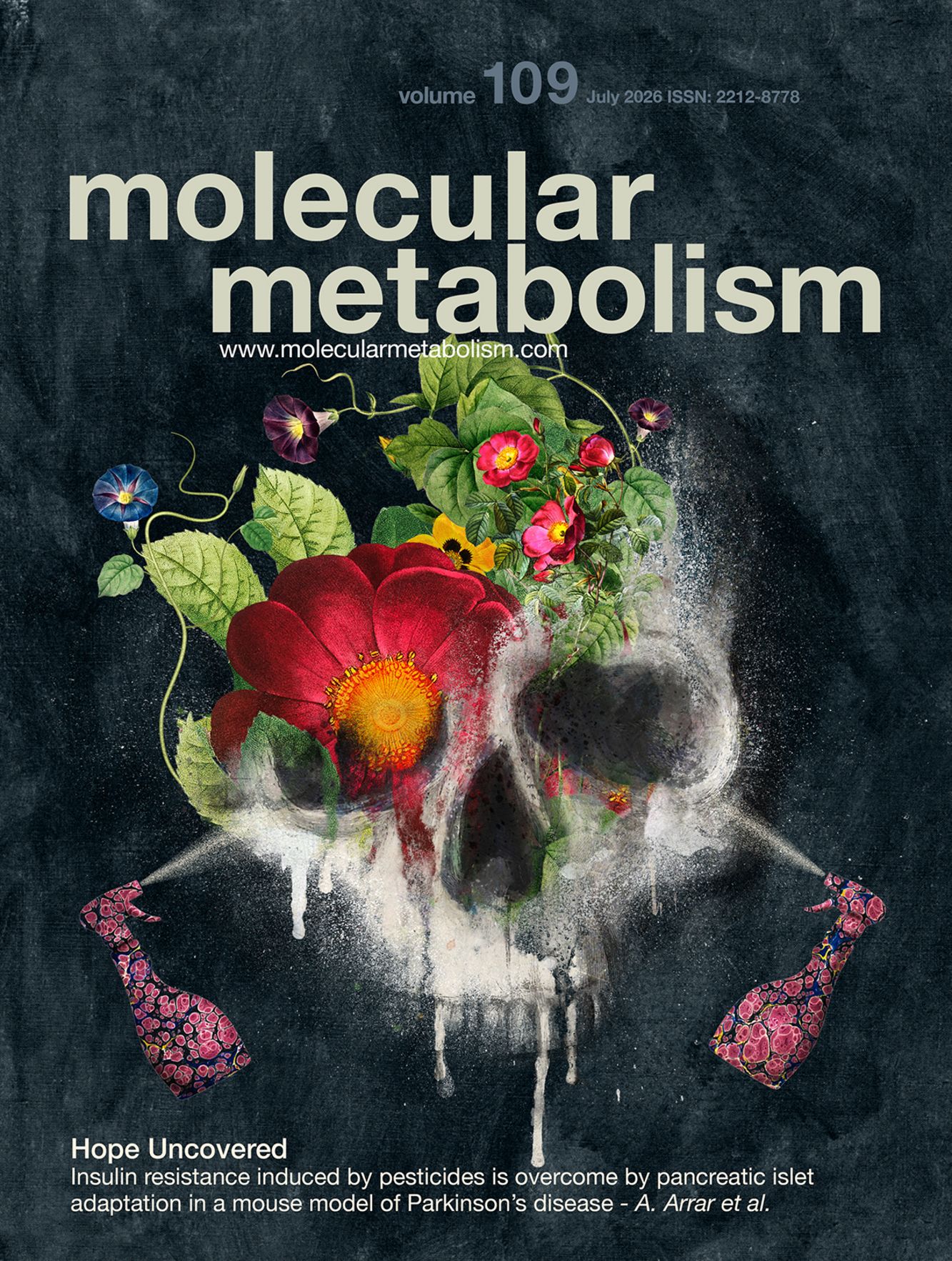
Cover Story Current Issue

The pancreas is a mixed gland primarily composed of exocrine tissue, which secretes digestive enzymes into the digestive tract, and an endocrine component organized into small clusters known as islets of Langerhans, constituting approximately 1% of the pancreatic mass. Each adult islet contains an average of 1,500 cells, including beta-, alpha- and delta-cells, which produce and secrete insulin (INS), glucagon (GCG), and somatostatin (SST) respectively. The destruction of insulin-producing beta-cells or the defective insulin secretion give rise to type 1 and type 2 diabetes mellitus, respectively. These chronic metabolic disorders are characterized by the dysregulation of glucose homeostasis. 

Full text


Current Issue

Myeloid-specific CAMKK2 deficiency protects against diet-induced obesity and insulin resistance by rewiring metabolic gene expression and enhancing energy expenditure

Andrea R. Ortiz, Kevin Nay, Brittany A. Stork, Adam M. Dean, ... John W. Scott

Myeloid-specific CAMKK2 deficiency protects against diet-induced obesity and insulin resistance by rewiring metabolic gene expression and enhancing energy expenditure

Objective

Obesity is associated with chronic, low-grade inflammation in metabolic tissues such as liver, adipose tissue and skeletal muscle implicating insulin resistance and type 2 diabetes as inflammatory diseases. This inflammatory response involves the accumulation of pro-inflammatory macrophages in these metabolically relevant organs. The Ca2+-calmodulin-dependent protein kinase kinase-2 (CAMKK2) is a key regulator of cellular and systemic energy metabolism, and a coordinator of macrophage-mediated inflammatory responses. However, its role in obesity-associated metabolic dysfunction is not fully defined. The aim of this study was to determine the contribution of CAMKK2 to the regulation of inflammation and systemic metabolism during diet-induced obesity.

Methods

Mice with myeloid-specific deletion of Camkk2 were generated and challenged with a high-fat diet. Metabolic phenotyping, histological analyses, and transcriptomic profiling were used to assess whole-body metabolism, liver lipid accumulation, and gene expression in macrophages and adipose tissue.

Results

Myeloid-specific Camkk2 deficiency protected mice from high fat diet-induced obesity, insulin resistance and liver steatosis. These protective effects were associated with rewiring of metabolic and inflammatory gene expression in both macrophages and adipose tissue, along with enhanced whole-body energy expenditure.

Conclusions

Our data establish CAMKK2 as an important regulator of macrophage function and putative therapeutic target for treating obesity and related metabolic disorders.

Articles in Press

Myeloid-specific CAMKK2 deficiency protects against diet-induced obesity and insulin resistance by rewiring metabolic gene expression and enhancing energy expenditure

Andrea R. Ortiz, Kevin Nay, Brittany A. Stork, Adam M. Dean, ... John W. Scott

Myeloid-specific CAMKK2 deficiency protects against diet-induced obesity and insulin resistance by rewiring metabolic gene expression and enhancing energy expenditure

Objective

Obesity is associated with chronic, low-grade inflammation in metabolic tissues such as liver, adipose tissue and skeletal muscle implicating insulin resistance and type 2 diabetes as inflammatory diseases. This inflammatory response involves the accumulation of pro-inflammatory macrophages in these metabolically relevant organs. The Ca2+-calmodulin-dependent protein kinase kinase-2 (CAMKK2) is a key regulator of cellular and systemic energy metabolism, and a coordinator of macrophage-mediated inflammatory responses. However, its role in obesity-associated metabolic dysfunction is not fully defined. The aim of this study was to determine the contribution of CAMKK2 to the regulation of inflammation and systemic metabolism during diet-induced obesity.

Methods

Mice with myeloid-specific deletion of Camkk2 were generated and challenged with a high-fat diet. Metabolic phenotyping, histological analyses, and transcriptomic profiling were used to assess whole-body metabolism, liver lipid accumulation, and gene expression in macrophages and adipose tissue.

Results

Myeloid-specific Camkk2 deficiency protected mice from high fat diet-induced obesity, insulin resistance and liver steatosis. These protective effects were associated with rewiring of metabolic and inflammatory gene expression in both macrophages and adipose tissue, along with enhanced whole-body energy expenditure.

Conclusions

Our data establish CAMKK2 as an important regulator of macrophage function and putative therapeutic target for treating obesity and related metabolic disorders.

2022 impact factor: 6.6

You are what you eat

Here is a video of Vimeo. When the iframes is activated, a connection to Vimeo is established and, if necessary, cookies from Vimeo are also used. For further information on cookies policy click here.

Auf Werbeinhalte, die vor, während oder nach Videos von WEBSITE-URL eingeblendet werden, hat WEBSITE-URL keinen Einfluss. Wir übernehmen keine Gewähr für diese Inhalte. Weitere Informationen finden Sie hier.