
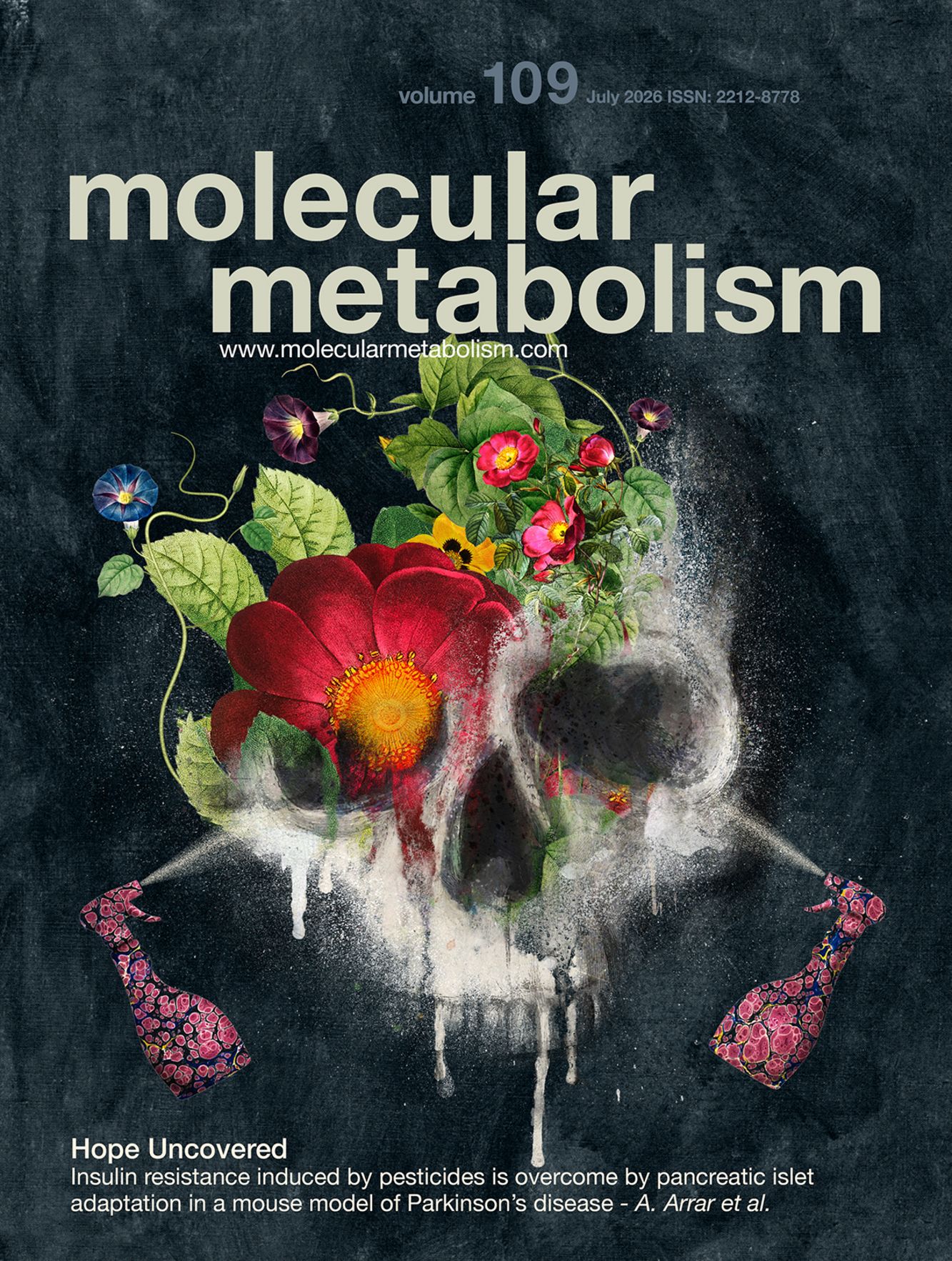


Cover Story Current Issue

Epidemiological evidences provide proof of concept that certain pesticides are involved in metabolic disorders, but also in the pathophysiology of Parkinson's disease (PD). In addition, large prospective cohort studies reported that type 2 diabetes (T2D) and PD are epidemiologically associated, including an elevated risk of developing PD in patients with T2D.
Current Issue
Effects of CT-388, a once-weekly signaling-biased dual GLP-1/GIP receptor agonist, on weight loss and glycemic control in preclinical models and participants with obesity

Effects of CT-388, a once-weekly signaling-biased dual GLP-1/GIP receptor agonist, on weight loss and glycemic control in preclinical models and participants with obesity
Biased agonism of the glucagon-like peptide-1/glucose-dependent insulinotropic polypeptide receptors (GLP-1R/GIPR) yields greater weight loss and better glycemic control than unbiased agonism in preclinical models. To evaluate whether biased agonism translates into improved efficacy for weight loss and glycemic control in clinical settings, we developed and characterized CT-388, a unimolecular peptide-based dual GLP-1R/GIPR agonist that is cAMP signal-biased at both receptors. In cell-based assays, CT-388 activated GLP-1R and GIPR with both having minimal receptor internalization vs their native ligands. CT-388 improved glycemic control in mice and monkeys, and reduced bodyweight, suppressed appetite, and improved metabolic dysfunction-associated steatohepatitis pathology in mice. In a phase 1, double-blind, randomized, placebo-controlled clinical study (NCT04838405) of CT-388 (subcutaneously administered single doses [0.5–7.5 mg] or 4 once-weekly doses [5–12 mg]) in otherwise healthy participants with overweight or obesity, CT-388 was generally well tolerated with a safety profile consistent with other incretin-based therapies; most treatment-emergent adverse events were mild or moderate. Glycemic parameters were improved during fasting conditions and an oral glucose tolerance test. The mean percent change in bodyweight from baseline to day 29 was −4.7% to −8.0% across CT-388 doses vs −0.5% with placebo. CT-388 pharmacokinetics supported once-weekly dosing. In conclusion, CT-388 demonstrated strong translatability from preclinical to clinical studies with consistent pharmacokinetics and pharmacodynamics across multiple species. In clinical settings, 4 weeks of CT-388 treatment produced clinically meaningful weight loss and improved glycemic control with favorable tolerability. These findings warrant further clinical evaluation of CT-388 for treating obesity and type 2 diabetes.
Articles in Press
Effects of CT-388, a once-weekly signaling-biased dual GLP-1/GIP receptor agonist, on weight loss and glycemic control in preclinical models and participants with obesity
Effects of CT-388, a once-weekly signaling-biased dual GLP-1/GIP receptor agonist, on weight loss and glycemic control in preclinical models and participants with obesity
Biased agonism of the glucagon-like peptide-1/glucose-dependent insulinotropic polypeptide receptors (GLP-1R/GIPR) yields greater weight loss and better glycemic control than unbiased agonism in preclinical models. To evaluate whether biased agonism translates into improved efficacy for weight loss and glycemic control in clinical settings, we developed and characterized CT-388, a unimolecular peptide-based dual GLP-1R/GIPR agonist that is cAMP signal-biased at both receptors. In cell-based assays, CT-388 activated GLP-1R and GIPR with both having minimal receptor internalization vs their native ligands. CT-388 improved glycemic control in mice and monkeys, and reduced bodyweight, suppressed appetite, and improved metabolic dysfunction-associated steatohepatitis pathology in mice. In a phase 1, double-blind, randomized, placebo-controlled clinical study (NCT04838405) of CT-388 (subcutaneously administered single doses [0.5–7.5 mg] or 4 once-weekly doses [5–12 mg]) in otherwise healthy participants with overweight or obesity, CT-388 was generally well tolerated with a safety profile consistent with other incretin-based therapies; most treatment-emergent adverse events were mild or moderate. Glycemic parameters were improved during fasting conditions and an oral glucose tolerance test. The mean percent change in bodyweight from baseline to day 29 was −4.7% to −8.0% across CT-388 doses vs −0.5% with placebo. CT-388 pharmacokinetics supported once-weekly dosing. In conclusion, CT-388 demonstrated strong translatability from preclinical to clinical studies with consistent pharmacokinetics and pharmacodynamics across multiple species. In clinical settings, 4 weeks of CT-388 treatment produced clinically meaningful weight loss and improved glycemic control with favorable tolerability. These findings warrant further clinical evaluation of CT-388 for treating obesity and type 2 diabetes.
Registration & Abstract Submission are open!

13th
Helmholtz Diabetes Conference
Munich, 21-23. Sep 2026

2024 impact factor: 6.6
You are what you eat
Here is a video of Vimeo. When the iframes is activated, a connection to Vimeo is established and, if necessary, cookies from Vimeo are also used. For further information on cookies policy click here.