
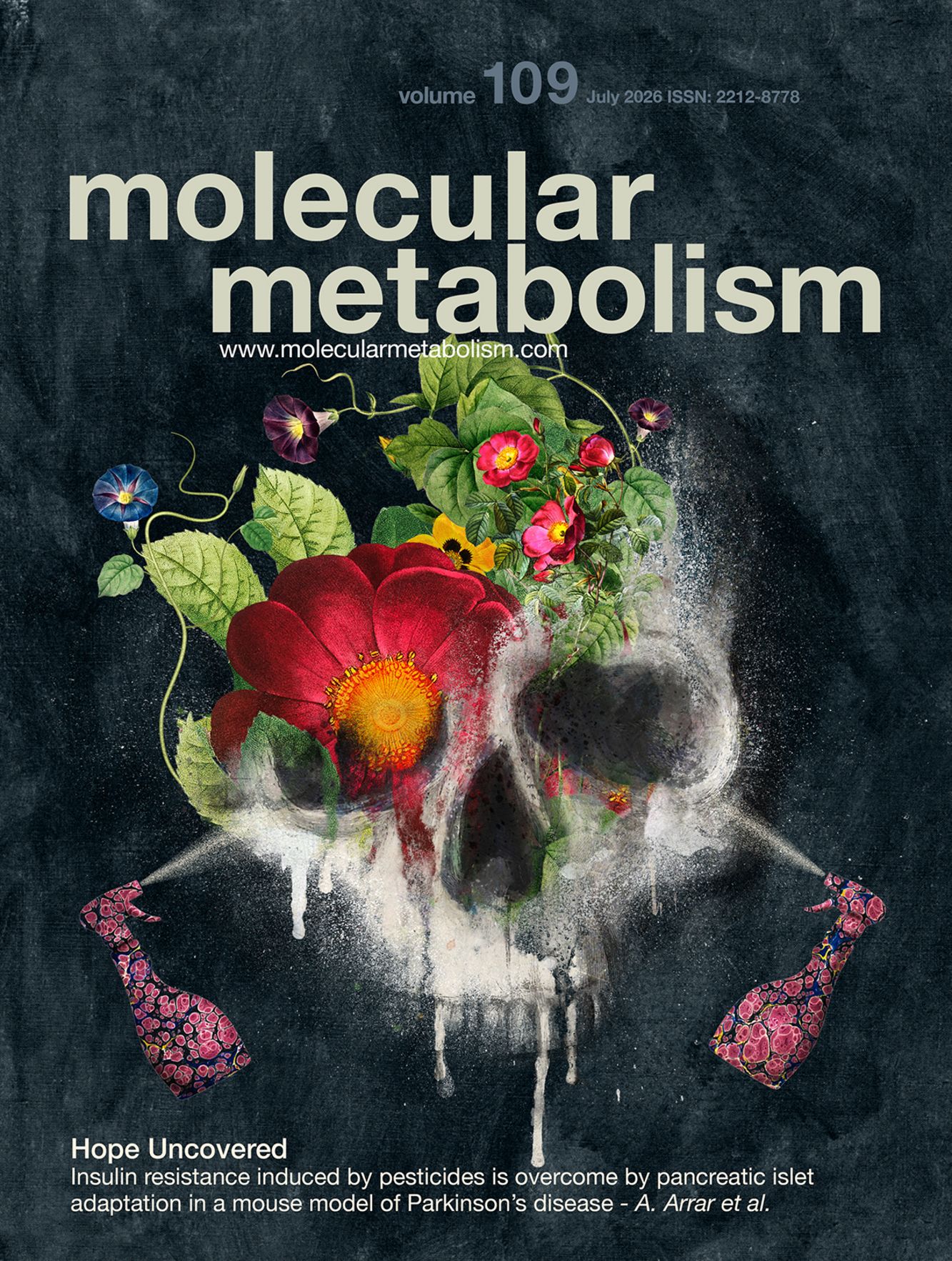


Cover Story Current Issue

Epidemiological evidences provide proof of concept that certain pesticides are involved in metabolic disorders, but also in the pathophysiology of Parkinson's disease (PD). In addition, large prospective cohort studies reported that type 2 diabetes (T2D) and PD are epidemiologically associated, including an elevated risk of developing PD in patients with T2D.
Current Issue
AgRP neuron activity predicts and tracks the glycemic response to oral glucose

AgRP neuron activity predicts and tracks the glycemic response to oral glucose
Hypothalamic AgRP neurons are uniquely responsive to nutritional cues and play an important role in fuel homeostasis. To investigate the temporal relationship between the activity of these neurons and the glycemic response to an oral glucose load, we simultaneously monitored AgRP neuron activity (by fiber photometry in AgRP-IRES-cre mice) and the arterial glucose level, both before and after oral gavage (OG) of either water or glucose (0.5–2.5 g/kg). We report that the AgRP neuron response to an OG glucose load can be subdivided into two functionally distinct phases – one that begins prior to glucose delivery and a second that extends from peak inhibition through the return towards baseline. The ‘first phase’ appears to be anticipatory in nature and is also predictive of subsequent changes in glycemia, suggesting a role in the handling of an oral glucose load. To analyze the relationship between the second phase response and changes of glycemia, we employed a model that allows residual activity to be removed subsequent to the ‘first phase’ component. This analysis reveals that unlike the first phase, the degree of residual inhibition – the second phase – tracks the glycemic response. Moreover, this response is temporally aligned with the blood glucose (BG) rate of change (which is predictive of future BG levels), with AgRP neurons lagging BG rate of change by ∼5 min. We conclude that the AgRP neuron response to an oral glucose challenge consists of two distinct phases, each with its own determinants and metabolic implications: an initial anticipatory component that is predictive of the subsequent glycemic response, and a second phase that tracks the rate of BG change.
Articles in Press
AgRP neuron activity predicts and tracks the glycemic response to oral glucose
AgRP neuron activity predicts and tracks the glycemic response to oral glucose
Hypothalamic AgRP neurons are uniquely responsive to nutritional cues and play an important role in fuel homeostasis. To investigate the temporal relationship between the activity of these neurons and the glycemic response to an oral glucose load, we simultaneously monitored AgRP neuron activity (by fiber photometry in AgRP-IRES-cre mice) and the arterial glucose level, both before and after oral gavage (OG) of either water or glucose (0.5–2.5 g/kg). We report that the AgRP neuron response to an OG glucose load can be subdivided into two functionally distinct phases – one that begins prior to glucose delivery and a second that extends from peak inhibition through the return towards baseline. The ‘first phase’ appears to be anticipatory in nature and is also predictive of subsequent changes in glycemia, suggesting a role in the handling of an oral glucose load. To analyze the relationship between the second phase response and changes of glycemia, we employed a model that allows residual activity to be removed subsequent to the ‘first phase’ component. This analysis reveals that unlike the first phase, the degree of residual inhibition – the second phase – tracks the glycemic response. Moreover, this response is temporally aligned with the blood glucose (BG) rate of change (which is predictive of future BG levels), with AgRP neurons lagging BG rate of change by ∼5 min. We conclude that the AgRP neuron response to an oral glucose challenge consists of two distinct phases, each with its own determinants and metabolic implications: an initial anticipatory component that is predictive of the subsequent glycemic response, and a second phase that tracks the rate of BG change.
Registration & Abstract Submission are open!

13th
Helmholtz Diabetes Conference
Munich, 21-23. Sep 2026

2024 impact factor: 6.6
You are what you eat
Here is a video of Vimeo. When the iframes is activated, a connection to Vimeo is established and, if necessary, cookies from Vimeo are also used. For further information on cookies policy click here.