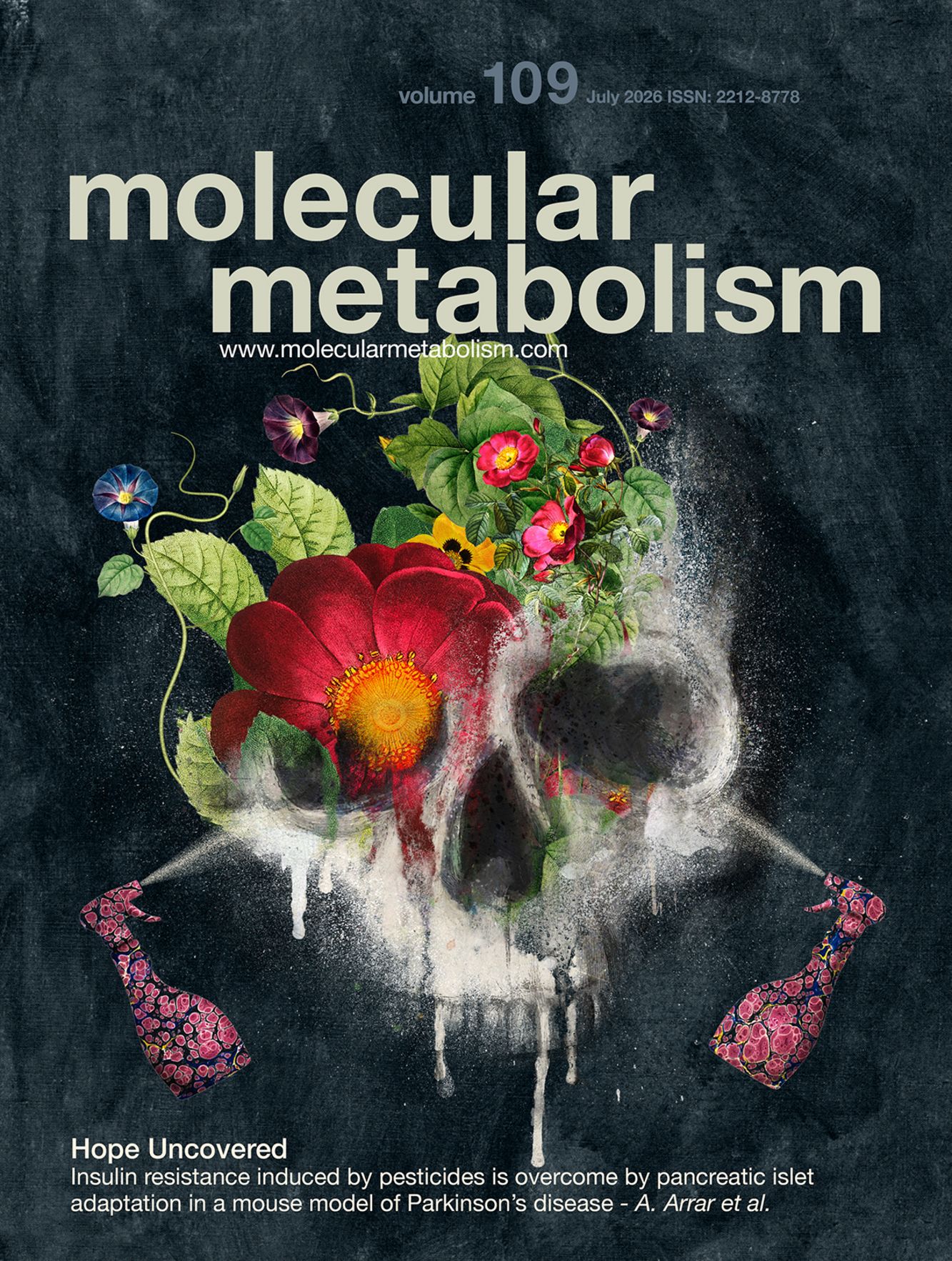
Cover Story Current Issue

Epidemiological evidences provide proof of concept that certain pesticides are involved in metabolic disorders, but also in the pathophysiology of Parkinson's disease (PD). In addition, large prospective cohort studies reported that type 2 diabetes (T2D) and PD are epidemiologically associated, including an elevated risk of developing PD in patients with T2D.

Full text


Current Issue

Metabolic plasticity and optimal redox homeostasis are essential for efficient metastatic colonization

Ece Grace, Deyu Zou, Romy Böttcher-Loschinski, Martin Böttcher, ... Marc P. Stemmler

Metabolic plasticity and optimal redox homeostasis are essential for efficient metastatic colonization


Cancer cells dynamically reprogram their metabolism to adapt to changing microenvironmental conditions during tumor growth and metastatic dissemination. Metastasis of solid tumors—the principal cause of cancer-related mortality—is often driven through activation of epithelial–mesenchymal transition (EMT), regulated by the transcription factor ZEB1, which is frequently upregulated during tumor progression. To investigate the role of metabolic plasticity in metastasis, we employed murine pancreatic ductal adenocarcinoma (PDAC) cell lines with distinct EMT states, ZEB1 expression and lung colonization capacities. Highly plastic epithelial-type cancer cells (KPCepi) efficiently colonize the lung, whereas Zeb1-deficient cancer cells (KPCZ) with compromised metabolic plasticity show markedly reduced colonization, correlated with absent glycolytic reserve, mitochondrial dysfunction, and reduced anti-oxidant metabolite levels. Interestingly, mesenchymal-type cancer cells (KPCmes) also exhibit poor lung colonization despite retaining normal glycolytic capacity and a high proportion of functional mitochondria; however, similar to KPCZ cells, they display diminished levels of detoxifying metabolites. Low metastatic capacity correlates with increased susceptibility to ferroptosis even in epithelial-type KPCZ cells, indicating a limited ability to counteract reactive oxygen species under stress. Together, these findings demonstrate that metabolic plasticity and redox homeostasis are essential prerequisites for efficient lung colonization. Thus, concurrent targeting of metabolic adaptability and redox buffering may represent a promising strategy to prevent metastasis in aggressive PDAC tumors.

  •  


Articles in Press

Metabolic plasticity and optimal redox homeostasis are essential for efficient metastatic colonization

Ece Grace, Deyu Zou, Romy Böttcher-Loschinski, Martin Böttcher, ... Marc P. Stemmler

Metabolic plasticity and optimal redox homeostasis are essential for efficient metastatic colonization


Cancer cells dynamically reprogram their metabolism to adapt to changing microenvironmental conditions during tumor growth and metastatic dissemination. Metastasis of solid tumors—the principal cause of cancer-related mortality—is often driven through activation of epithelial–mesenchymal transition (EMT), regulated by the transcription factor ZEB1, which is frequently upregulated during tumor progression. To investigate the role of metabolic plasticity in metastasis, we employed murine pancreatic ductal adenocarcinoma (PDAC) cell lines with distinct EMT states, ZEB1 expression and lung colonization capacities. Highly plastic epithelial-type cancer cells (KPCepi) efficiently colonize the lung, whereas Zeb1-deficient cancer cells (KPCZ) with compromised metabolic plasticity show markedly reduced colonization, correlated with absent glycolytic reserve, mitochondrial dysfunction, and reduced anti-oxidant metabolite levels. Interestingly, mesenchymal-type cancer cells (KPCmes) also exhibit poor lung colonization despite retaining normal glycolytic capacity and a high proportion of functional mitochondria; however, similar to KPCZ cells, they display diminished levels of detoxifying metabolites. Low metastatic capacity correlates with increased susceptibility to ferroptosis even in epithelial-type KPCZ cells, indicating a limited ability to counteract reactive oxygen species under stress. Together, these findings demonstrate that metabolic plasticity and redox homeostasis are essential prerequisites for efficient lung colonization. Thus, concurrent targeting of metabolic adaptability and redox buffering may represent a promising strategy to prevent metastasis in aggressive PDAC tumors.

  •  


Registration & Abstract Submission are open!

13th
Helmholtz Diabetes Conference 

Munich, 21-23. Sep 2026                                                                                                                             

2024 impact factor: 6.6

You are what you eat

Here is a video of Vimeo. When the iframes is activated, a connection to Vimeo is established and, if necessary, cookies from Vimeo are also used. For further information on cookies policy click here.

Auf Werbeinhalte, die vor, während oder nach Videos von WEBSITE-URL eingeblendet werden, hat WEBSITE-URL keinen Einfluss. Wir übernehmen keine Gewähr für diese Inhalte. Weitere Informationen finden Sie hier.