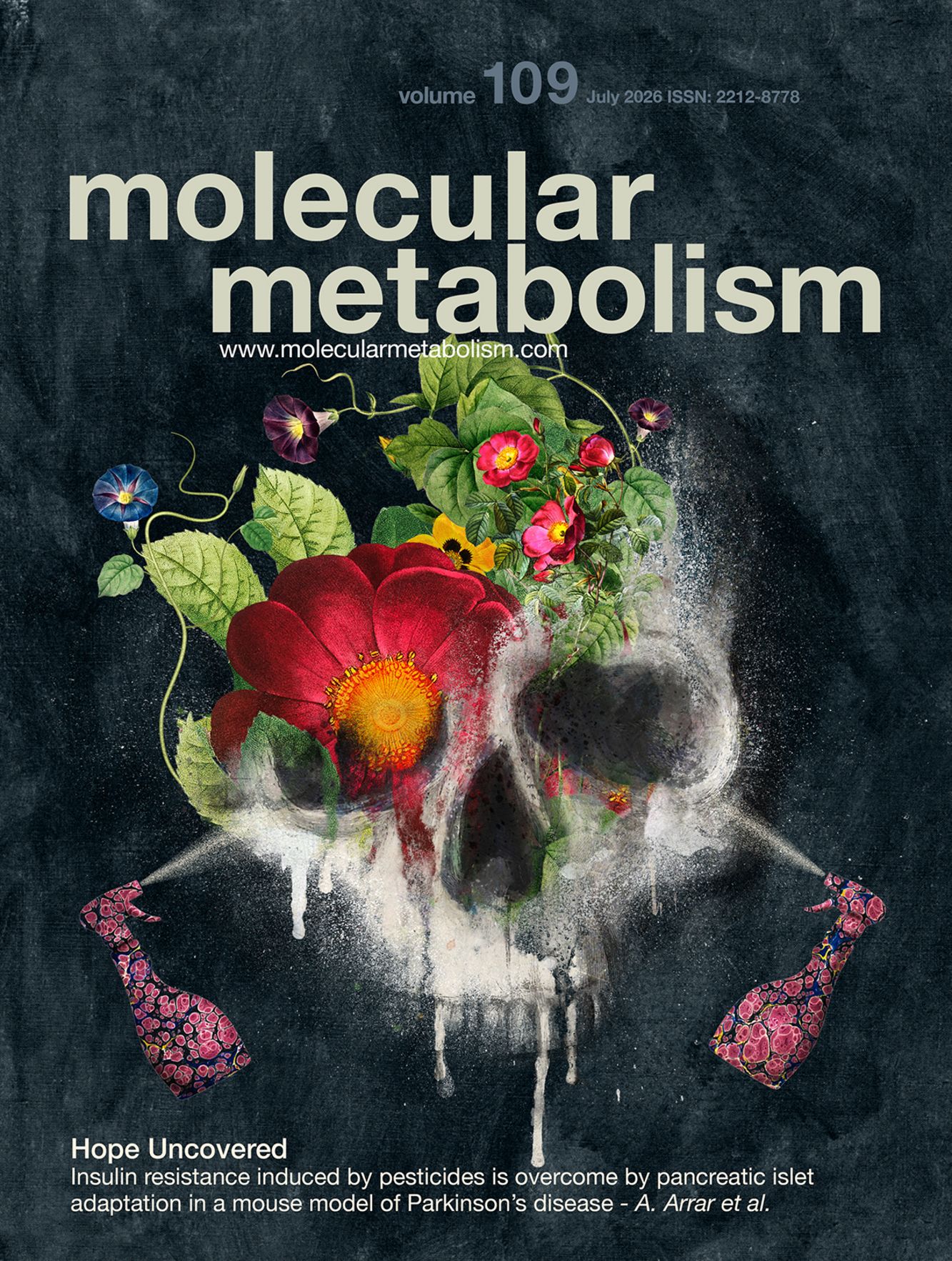
Cover Story Current Issue

Epidemiological evidences provide proof of concept that certain pesticides are involved in metabolic disorders, but also in the pathophysiology of Parkinson's disease (PD). In addition, large prospective cohort studies reported that type 2 diabetes (T2D) and PD are epidemiologically associated, including an elevated risk of developing PD in patients with T2D.

Full text


Current Issue

Maternal obesity and the embryonic rewiring of feeding circuits: Beyond the hypothalamus

Dionysios V. Chartoumpekis, Aristea Psilopanagioti

Maternal obesity and the embryonic rewiring of feeding circuits: Beyond the hypothalamus

Maternal obesity disrupts fetal hypothalamic development by inducing structural changes in feeding circuits, such as reduced hypothalamic precursor proliferation, blunted energy-status sensing, and aberrant wiring of melanocortin pathways, ultimately promoting long-term obesity risk in offspring. Although this hypothalamic reprogramming has dominated research, emerging evidence supports a broader, distributed model involving both brainstem interoceptive circuits and mesocorticolimbic reward-control systems. Maternal obesity is associated with impaired white matter development in offspring, as well as compromised functional connectivity, abnormal orexigenic and anorexigenic signaling, hypothalamic inflammation, and epigenetic alterations in neurodevelopmental genes. Human neuroimaging studies demonstrate altered network connectivity in neonates associated with maternal adiposity. However, the mechanism through which dysregulated maternal signals ultimately reach and reprogram the developing brain remains largely elusive. The present review aims to elucidate the mechanisms by which maternal overnutrition drives the embryonic rewiring of feeding circuits beyond the hypothalamus, highlighting the susceptibility of these extra-hypothalamic neural networks to obesogenic programming. Future research should prioritize investigating the effects of maternal obesity on fetal cytoarchitecture and function in feeding-related neuroanatomical circuits, including brainstem interoceptive nuclei and mesocorticolimbic reward–control pathways. Elucidating these developmental neuro-metabolic changes may offer the opportunity to establish early intervention measures for preserving offspring metabolic health.

Articles in Press

Maternal obesity and the embryonic rewiring of feeding circuits: Beyond the hypothalamus

Dionysios V. Chartoumpekis, Aristea Psilopanagioti

Maternal obesity and the embryonic rewiring of feeding circuits: Beyond the hypothalamus

Maternal obesity disrupts fetal hypothalamic development by inducing structural changes in feeding circuits, such as reduced hypothalamic precursor proliferation, blunted energy-status sensing, and aberrant wiring of melanocortin pathways, ultimately promoting long-term obesity risk in offspring. Although this hypothalamic reprogramming has dominated research, emerging evidence supports a broader, distributed model involving both brainstem interoceptive circuits and mesocorticolimbic reward-control systems. Maternal obesity is associated with impaired white matter development in offspring, as well as compromised functional connectivity, abnormal orexigenic and anorexigenic signaling, hypothalamic inflammation, and epigenetic alterations in neurodevelopmental genes. Human neuroimaging studies demonstrate altered network connectivity in neonates associated with maternal adiposity. However, the mechanism through which dysregulated maternal signals ultimately reach and reprogram the developing brain remains largely elusive. The present review aims to elucidate the mechanisms by which maternal overnutrition drives the embryonic rewiring of feeding circuits beyond the hypothalamus, highlighting the susceptibility of these extra-hypothalamic neural networks to obesogenic programming. Future research should prioritize investigating the effects of maternal obesity on fetal cytoarchitecture and function in feeding-related neuroanatomical circuits, including brainstem interoceptive nuclei and mesocorticolimbic reward–control pathways. Elucidating these developmental neuro-metabolic changes may offer the opportunity to establish early intervention measures for preserving offspring metabolic health.

Registration & Abstract Submission are open!

13th
Helmholtz Diabetes Conference 

Munich, 21-23. Sep 2026                                                                                                                             

2024 impact factor: 6.6

You are what you eat

Here is a video of Vimeo. When the iframes is activated, a connection to Vimeo is established and, if necessary, cookies from Vimeo are also used. For further information on cookies policy click here.

Auf Werbeinhalte, die vor, während oder nach Videos von WEBSITE-URL eingeblendet werden, hat WEBSITE-URL keinen Einfluss. Wir übernehmen keine Gewähr für diese Inhalte. Weitere Informationen finden Sie hier.