
 Volume 109, Current Issue
 Vol 28, October 2019
 Vol 27, September 2019
 Vol 26, August 2019
 Vol 25, July 2019
 Vol 24, June 2019
 Vol 23, May 2019
 Vol 22, April 2019
 Vol 21, March 2019
 Vol 20, February 2019
 Vol 19, January 2019
 Vol 18, December 2018
 Vol 17, November 2018
 Vol 16, October 2018
 Vol 15, September 2018
 Vol 14, August 2018
 Vol 13, July 2018
 Vol 12, June 2018
 Vol 11, May 2018
 Vol 10, April 2018
 Vol 9, March 2018
 Vol 8, February 2018
 Vol 7, January 2018
 Vol 6 No 12, December 2017
 Vol 6 No 11, November 2017
 Vol 6 No 10, October 2017
 Vol 6 No 9, September 2017
 Vol 6 No 8, August 2017
 Vol 6 No 7, July 2017
 Vol 6 No 6, June 2017
 Vol 6 No 5, May 2017
 Vol 6 No 4, April 2017
 Vol 6 No 3, March 2017
 Vol 6 No 2, February 2017
 Vol 6 No 1, January 2017
 Vol 5 No 12, December 2016
 Vol 5 No 11, November 2016
 Vol 5 No 10, October 2016
 Vol 5 No 9, September 2016
 Vol 5 No 8, August 2016
 Vol 5 No 7, July 2016
 Vol 5 No 6, June 2016
 Vol 5 No 5, May 2016
 Vol 5 No 4, April 2016
 Vol 5 No 3, March 2016
 Vol 5 No 2, February 2016
 Vol 5 No 1, January 2016
 Vol 4 No 12, December 2015
 Vol 4 No 11, November 2015
 Vol 4 No 10, October 2015


Cover Story Current Issue
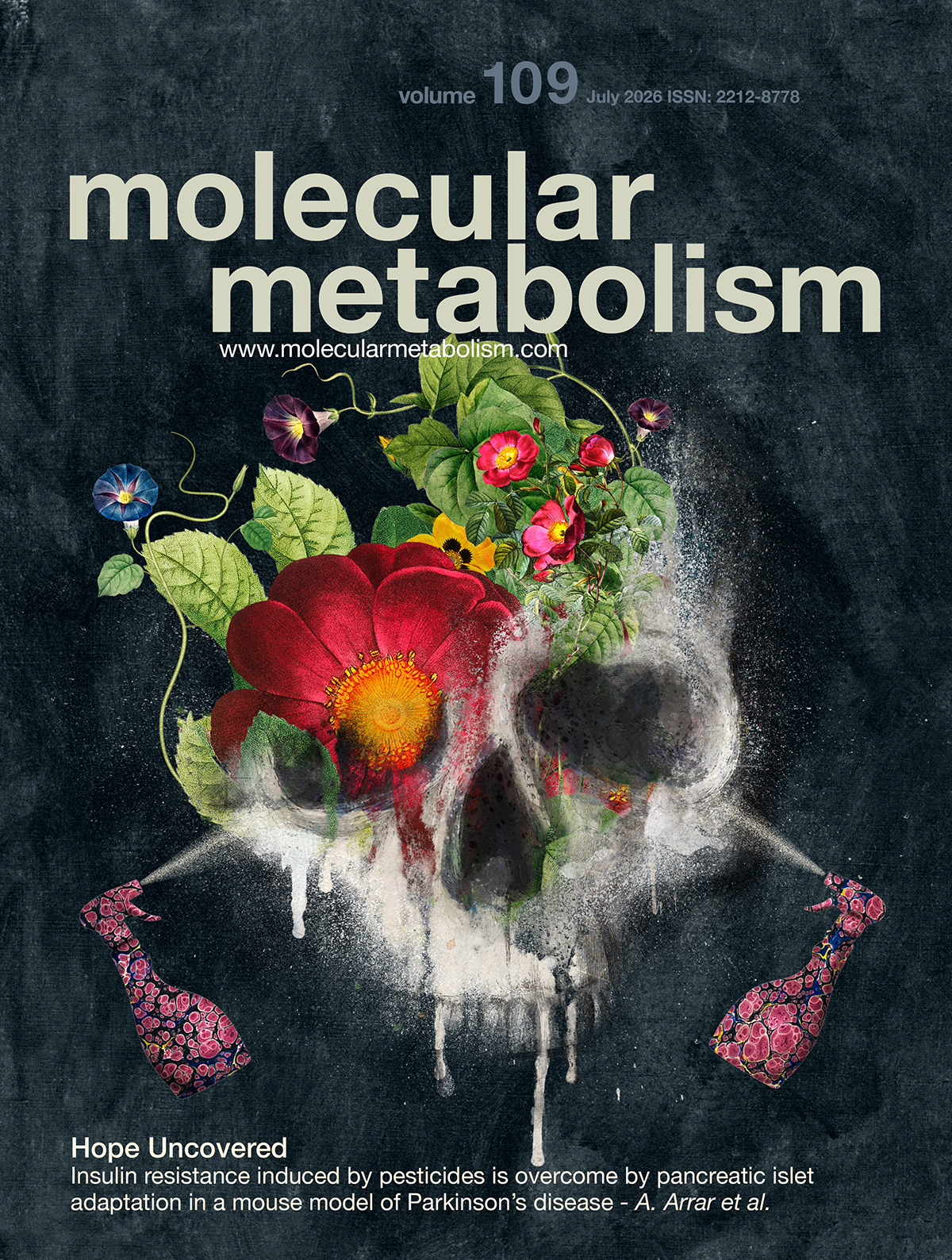
Epidemiological evidences provide proof of concept that certain pesticides are involved in metabolic disorders, but also in the pathophysiology of Parkinson's disease (PD). In addition, large prospective cohort studies reported that type 2 diabetes (T2D) and PD are epidemiologically associated, including an elevated risk of developing PD in patients with T2D.
Current Issue
The transcription factor CUX1 exerts opposing roles in human and mouse adipocyte differentiation
- Abstract
The transcription factor CUX1 exerts opposing roles in human and mouse adipocyte differentiation
Objective
Adipocyte differentiation is critical for the metabolically protective expansion of adipose tissue. Impaired differentiation drives lipodystrophy and pathologic tissue remodeling, major contributors to cardiometabolic diseases. The differentiation process is governed by master transcription factors, including the pioneer factor C/EBPβ, which initiates the adipogenic program. Here, we sought to identify novel C/EBPβ-associated factors that regulate human adipocyte differentiation.
Methods
We used chromatin immunoprecipitation followed by selective isolation of chromatin-associated proteins (ChIP-SICAP) to identify proteins that interact with C/EBPβ on chromatin during human adipocyte differentiation. Candidate factors were assessed for their effects on differentiation, through conducting a CRISPR/Cas9-based knockout screen in human adipocyte precursor cells (hAPCs). The transcription factor CUX1 emerged as a top candidate. We performed gain- and loss-of-function studies in primary human and mouse adipocyte differentiation models, coupled with RNA-seq and ChIP-seq, to define CUX1-regulated genes and pathways. In vivo relevance was tested using adipocyte precursor–selective Cux1 knockout and lineage reporter mice.
Results
Loss of CUX1 impaired, whereas its overexpression enhanced, adipocyte differentiation in hAPCs. RNA-seq and ChIP-seq analyses revealed that CUX1 promotes the expression of key adipogenic genes, including PPARG in hAPCs. By contrast, CUX1 exerted the opposite effect in mouse adipocyte differentiation. Cux1 deletion enhanced, while CUX1 overexpression suppressed, differentiation in mouse APCs (mAPCs). CUX1 exhibited distinct chromatin-binding patterns and motif enrichment profiles in mouse versus human cells. In vivo, Cux1 deletion in APCs of mice increased de novo adipocyte formation during early stages of obesity development.
Conclusions
The transcription factor CUX1 regulates adipocyte differentiation in opposite directions in humans and mice, emphasizing the need for species-specific models in metabolic disease research,
Articles in Press
The transcription factor CUX1 exerts opposing roles in human and mouse adipocyte differentiation
- Abstract
The transcription factor CUX1 exerts opposing roles in human and mouse adipocyte differentiation
Objective
Adipocyte differentiation is critical for the metabolically protective expansion of adipose tissue. Impaired differentiation drives lipodystrophy and pathologic tissue remodeling, major contributors to cardiometabolic diseases. The differentiation process is governed by master transcription factors, including the pioneer factor C/EBPβ, which initiates the adipogenic program. Here, we sought to identify novel C/EBPβ-associated factors that regulate human adipocyte differentiation.
Methods
We used chromatin immunoprecipitation followed by selective isolation of chromatin-associated proteins (ChIP-SICAP) to identify proteins that interact with C/EBPβ on chromatin during human adipocyte differentiation. Candidate factors were assessed for their effects on differentiation, through conducting a CRISPR/Cas9-based knockout screen in human adipocyte precursor cells (hAPCs). The transcription factor CUX1 emerged as a top candidate. We performed gain- and loss-of-function studies in primary human and mouse adipocyte differentiation models, coupled with RNA-seq and ChIP-seq, to define CUX1-regulated genes and pathways. In vivo relevance was tested using adipocyte precursor–selective Cux1 knockout and lineage reporter mice.
Results
Loss of CUX1 impaired, whereas its overexpression enhanced, adipocyte differentiation in hAPCs. RNA-seq and ChIP-seq analyses revealed that CUX1 promotes the expression of key adipogenic genes, including PPARG in hAPCs. By contrast, CUX1 exerted the opposite effect in mouse adipocyte differentiation. Cux1 deletion enhanced, while CUX1 overexpression suppressed, differentiation in mouse APCs (mAPCs). CUX1 exhibited distinct chromatin-binding patterns and motif enrichment profiles in mouse versus human cells. In vivo, Cux1 deletion in APCs of mice increased de novo adipocyte formation during early stages of obesity development.
Conclusions
The transcription factor CUX1 regulates adipocyte differentiation in opposite directions in humans and mice, emphasizing the need for species-specific models in metabolic disease research,
Registration & Abstract Submission are open!

13th
Helmholtz Diabetes Conference
Munich, 21-23. Sep 2026

2024 impact factor: 6.6
You are what you eat
Here is a video of Vimeo. When the iframes is activated, a connection to Vimeo is established and, if necessary, cookies from Vimeo are also used. For further information on cookies policy click here.