

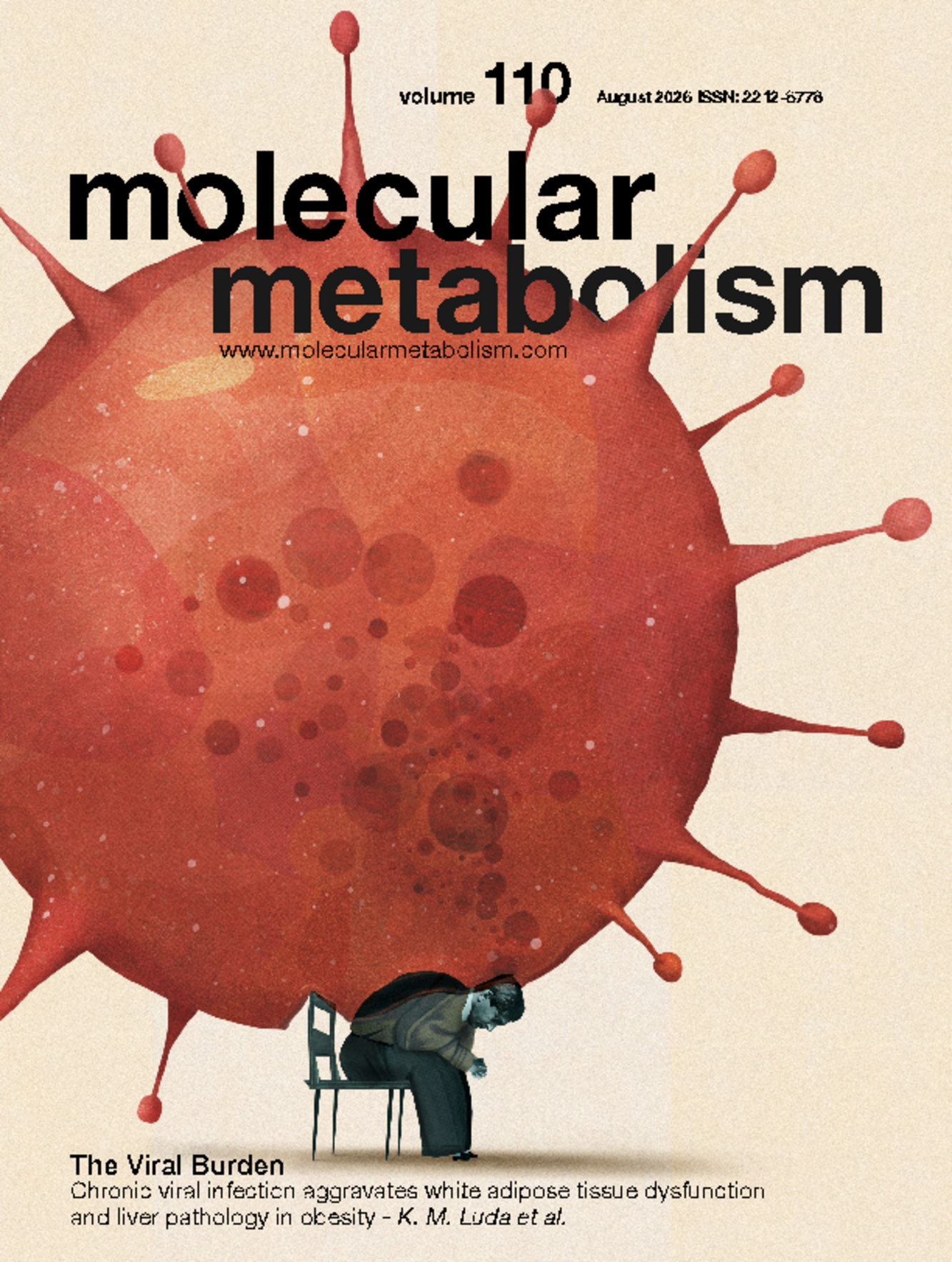



Cover Story Current Issue

Skeletal muscle is the largest organ in the human body by mass, making up approximately 40 % of total body weight. Furthermore, it accounts for the majority of insulin-stimulated glucose uptake and is also highly involved in lipid metabolism. Lipids can accumulate in muscle through different distinct depots: as intramyocellular lipids (IMCL), stored as triglyceride-containing droplets within muscle cells and as intermuscular adipose tissue (IMAT), located between muscle fiber bundles beneath the deep muscle fascia. The muscular fat depots have been positively correlated with an increased body fat content in obesity, just like subcutaneous and visceral adipose tissue (SAT and VAT, respectively). IMCL, IMAT, VAT and SAT have additionally been linked to insulin resistance and type 2 diabetes mellitus (T2D).
Current Issue
TGFβ activity stabilizes ACC1 to increase de novo lipogenesis in metabolic liver disease
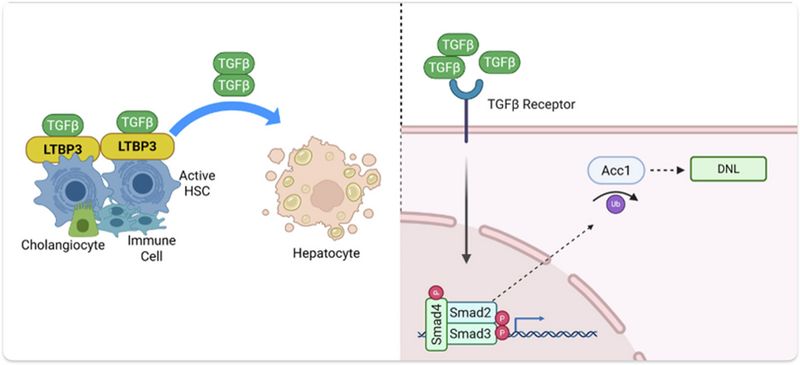
TGFβ activity stabilizes ACC1 to increase de novo lipogenesis in metabolic liver disease
Metabolic liver disease arises due to dysregulated signaling between hepatocytes and non-parenchymal cells (NPCs). Through parallel RNA sequencing screens in diet-induced and genetic mouse models, backdropped by human transcriptomic data, we identified latent TGFβ binding protein-3 (LTBP3) – a regulator of TGFβ secretion – as a novel contributor to metabolic liver disease pathogenesis. GalNAc-conjugated Ltbp3 ASO reduced hepatic triglyceride accumulation in diet-induced metabolic liver disease mouse models, which was phenocopied in mice lacking hepatocyte TGFβ activity, but surprisingly not in hepatocyte-specific Ltbp3 knockout mice. This discordance prompted evaluation as to whether GalNAc-based tools are hepatocyte-specific. In fact, we found that GalNAc-Ltbp3 ASO also targeted multiple NPC populations, reducing intrahepatic TGFβ activity, culminating to lowered lipid content by increased proteasomal degradation of the key lipogenic enzyme Acetyl-CoA-Carboxylase 1 (ACC1) in hepatocytes. These data reveal a previously unrecognized NPC-hepatocyte axis to regulate lipogenesis in metabolic liver disease.
Articles in Press
TGFβ activity stabilizes ACC1 to increase de novo lipogenesis in metabolic liver disease
TGFβ activity stabilizes ACC1 to increase de novo lipogenesis in metabolic liver disease
Metabolic liver disease arises due to dysregulated signaling between hepatocytes and non-parenchymal cells (NPCs). Through parallel RNA sequencing screens in diet-induced and genetic mouse models, backdropped by human transcriptomic data, we identified latent TGFβ binding protein-3 (LTBP3) – a regulator of TGFβ secretion – as a novel contributor to metabolic liver disease pathogenesis. GalNAc-conjugated Ltbp3 ASO reduced hepatic triglyceride accumulation in diet-induced metabolic liver disease mouse models, which was phenocopied in mice lacking hepatocyte TGFβ activity, but surprisingly not in hepatocyte-specific Ltbp3 knockout mice. This discordance prompted evaluation as to whether GalNAc-based tools are hepatocyte-specific. In fact, we found that GalNAc-Ltbp3 ASO also targeted multiple NPC populations, reducing intrahepatic TGFβ activity, culminating to lowered lipid content by increased proteasomal degradation of the key lipogenic enzyme Acetyl-CoA-Carboxylase 1 (ACC1) in hepatocytes. These data reveal a previously unrecognized NPC-hepatocyte axis to regulate lipogenesis in metabolic liver disease.
Registration still open - sign up now!

13th
Helmholtz Diabetes Conference
Munich, 21-23. Sep 2026

2024 impact factor: 6.6
You are what you eat
Here is a video of Vimeo. When the iframes is activated, a connection to Vimeo is established and, if necessary, cookies from Vimeo are also used. For further information on cookies policy click here.