Cover Story Current Issue

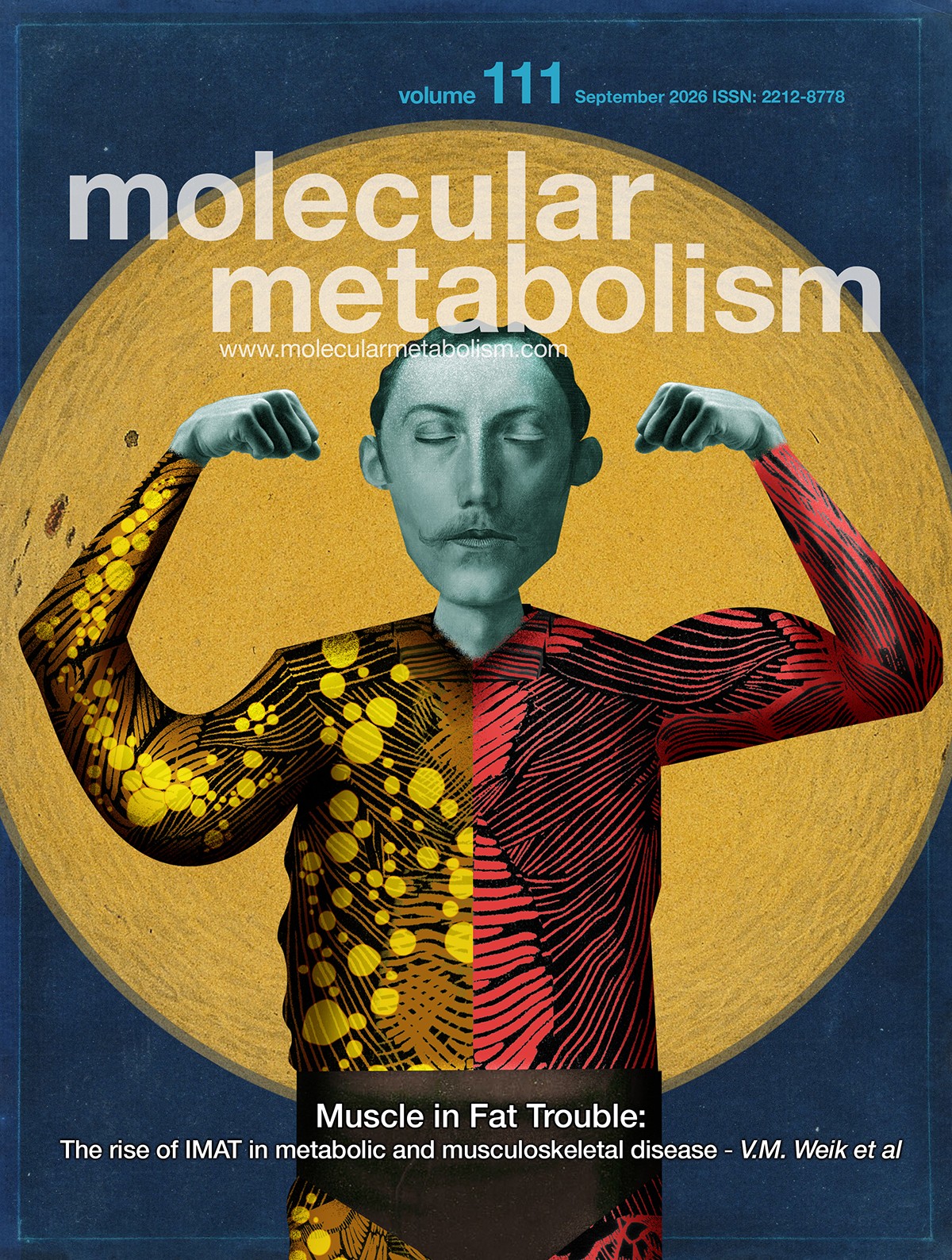
Skeletal muscle is the largest organ in the human body by mass, making up approximately 40 % of total body weight. Furthermore, it accounts for the majority of insulin-stimulated glucose uptake and is also highly involved in lipid metabolism. Lipids can accumulate in muscle through different distinct depots: as intramyocellular lipids (IMCL), stored as triglyceride-containing droplets within muscle cells and as intermuscular adipose tissue (IMAT), located between muscle fiber bundles beneath the deep muscle fascia. The muscular fat depots have been positively correlated with an increased body fat content in obesity, just like subcutaneous and visceral adipose tissue (SAT and VAT, respectively). IMCL, IMAT, VAT and SAT have additionally been linked to insulin resistance and type 2 diabetes mellitus (T2D).

Full text


Current Issue

Neuronal ketone body utilization couples exercise and time-restricted feeding to cognitive enhancement

Sebastian F. Salathe, Benjamin A. Kugler, Edziu Franczak, Xin C. Davis, ... John P. Thyfault

Neuronal ketone body utilization couples exercise and time-restricted feeding to cognitive enhancement


Objective

Ketone body metabolism is linked to brain health benefits, including delaying age-related cognitive decline. Exercise, particularly when combined with an overnight fast, stimulates ketone body turnover and improves brain metabolism and cognition. Yet, whether ketone metabolism is obligatory for this response is unknown. Here, we use chronic exercise via voluntary wheel running plus time-restricted feeding (VWR + TRF) to explore whether ketones mediate exercise-induced brain health benefits in middle-aged mice.

Methods

To distinguish the roles of neuronal ketone metabolism vs. hepatic ketone production, we studied middle-age female neuronal-specific SCOT knockout mice and hepatocyte-specific HMGCS2 knockout mice, respectively. VWR + TRF was compared to sedentary ad-libitum fed mice to assess the impact on whole-body metabolism, cognition, and hippocampal molecular adaptations. VWR + TRF upregulated systemic lipid oxidation in all mice during the fasting period.

Results

In female SCOT-Neuron-KO mice, we show impaired responses to VWR + TRF in indices of short- and long-term memory. Proteomic analysis of isolated hippocampi revealed that SCOT-Neuron-KO mice failed to globally upregulate key facilitators of synaptic function, including leucine-rich repeated transmembrane proteins, neurexins, and neuroligins. In female HMGCS2-Liver-KO mice, impaired responses to VWR + TRF in indices of short-term memory were paired with an upregulation in hippocampal ketogenesis machinery, suggesting potential in vivo evidence of cerebral ketogenesis, a mechanism mitigating an otherwise more pronounced behavioral phenotype.

Conclusion

Together, these findings suggest that neuronal ketone body utilization is essential for, while hepatic-derived ketone bodies contribute to, the full cognitive and synaptic adaptations to VWR + TRF, supporting ketone metabolism as a key mechanistic link between metabolic state and brain health in midlife.


Articles in Press

Neuronal ketone body utilization couples exercise and time-restricted feeding to cognitive enhancement

Sebastian F. Salathe, Benjamin A. Kugler, Edziu Franczak, Xin C. Davis, ... John P. Thyfault

Neuronal ketone body utilization couples exercise and time-restricted feeding to cognitive enhancement


Objective

Ketone body metabolism is linked to brain health benefits, including delaying age-related cognitive decline. Exercise, particularly when combined with an overnight fast, stimulates ketone body turnover and improves brain metabolism and cognition. Yet, whether ketone metabolism is obligatory for this response is unknown. Here, we use chronic exercise via voluntary wheel running plus time-restricted feeding (VWR + TRF) to explore whether ketones mediate exercise-induced brain health benefits in middle-aged mice.

Methods

To distinguish the roles of neuronal ketone metabolism vs. hepatic ketone production, we studied middle-age female neuronal-specific SCOT knockout mice and hepatocyte-specific HMGCS2 knockout mice, respectively. VWR + TRF was compared to sedentary ad-libitum fed mice to assess the impact on whole-body metabolism, cognition, and hippocampal molecular adaptations. VWR + TRF upregulated systemic lipid oxidation in all mice during the fasting period.

Results

In female SCOT-Neuron-KO mice, we show impaired responses to VWR + TRF in indices of short- and long-term memory. Proteomic analysis of isolated hippocampi revealed that SCOT-Neuron-KO mice failed to globally upregulate key facilitators of synaptic function, including leucine-rich repeated transmembrane proteins, neurexins, and neuroligins. In female HMGCS2-Liver-KO mice, impaired responses to VWR + TRF in indices of short-term memory were paired with an upregulation in hippocampal ketogenesis machinery, suggesting potential in vivo evidence of cerebral ketogenesis, a mechanism mitigating an otherwise more pronounced behavioral phenotype.

Conclusion

Together, these findings suggest that neuronal ketone body utilization is essential for, while hepatic-derived ketone bodies contribute to, the full cognitive and synaptic adaptations to VWR + TRF, supporting ketone metabolism as a key mechanistic link between metabolic state and brain health in midlife.


Registration still open - sign up now!

13th
Helmholtz Diabetes Conference 

Munich, 21-23. Sep 2026                                                                                                                             

2024 impact factor: 6.6

You are what you eat

Here is a video of Vimeo. When the iframes is activated, a connection to Vimeo is established and, if necessary, cookies from Vimeo are also used. For further information on cookies policy click here.

Auf Werbeinhalte, die vor, während oder nach Videos von WEBSITE-URL eingeblendet werden, hat WEBSITE-URL keinen Einfluss. Wir übernehmen keine Gewähr für diese Inhalte. Weitere Informationen finden Sie hier.